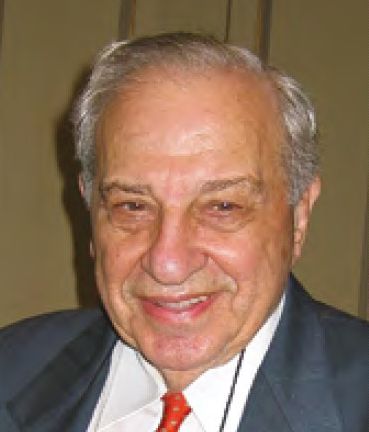
Professor Rudolph A. Marcus (born July 21, 1923, in Montreal, Quebec), known to all as Rudy Marcus, the John G. Kirkwood and Arthur A. Noyes Professor of Chemistry at Caltech, passed away at his home on July 16, 2026, five days short of his 103rd birthday. His theory of electron transfer, recognized with the 1992 Nobel Prize in Chemistry, gave electrochemistry its central framework for how driving force and reorganization govern reaction rates, including the celebrated prediction of the inverted region, confirmed experimentally decades after he made it.
Marcus developed the first comprehensive theory of electron transfer, demonstrating that the rate of electron exchange is governed not only by the intrinsic electronic coupling between donor and acceptor but also by the reorganization of their molecular and surrounding solvent environments. The resulting Marcus Theory introduced the concept of reorganization energy, providing a quantitative description of activation barriers for electron transfer reactions and predicting the remarkable “Marcus inverted region,” later confirmed experimentally. These concepts have become indispensable for interpreting heterogeneous electron transfer at electrode/electrolyte interfaces, electrochemical kinetics, semiconductor electrochemistry, molecular electronics, photo-electrochemistry, and electrocatalytic processes.
The influence of Marcus’s work extends throughout contemporary electrochemical science. His theoretical framework forms the basis for understanding electron transfer in fuel cells, batteries, electrochemical CO₂ reduction, nitrogen fixation, hydrogen evolution and oxidation, oxygen electrocatalysis, corrosion, and bio-electrochemical systems. Marcus Theory has also provided a bridge between chemistry, physics, materials science, and biology, enabling the rational design of redox-active molecules, catalysts, and functional materials for sustainable energy technologies. Modern computational electrochemistry and atomistic simulations of electrochemical interfaces continue to rely heavily on the principles he established.
Beyond his extraordinary scientific achievements, Rudy Marcus was admired for his intellectual rigor, humility, generosity, and lifelong curiosity. His work exemplified the power of fundamental theory to illuminate complex experimental observations and inspire generations of scientists across multiple disciplines. His legacy will endure through the countless discoveries made possible by his ideas and through the many researchers whose careers have been shaped by his profound contributions to electron transfer and electrochemical science. The electrochemical community has lost one of its greatest visionaries, but his scientific influence will continue to guide the field for generations to come.
From his arrival at Caltech in 1978 to his final months, Rudy never stopped: he published across nearly eight decades, mentored generations of students including undergraduate researchers as recently as 2024 and was at work on three papers when he passed. Those of us who saw him on campus will remember his gentle humor, his curiosity, and the generosity with which he shared his time. His ideas are woven into nearly everything the electrochemistry community does.
On behalf of the International Society of Electrochemistry,
With deepest respect,
Plamen Atanassov, University of California Irvine and
Karthish Manthiram, California Institute of Technology
Andrea Russell, University of Southampton,
Katharina Krischer, Technical University of Munich
Francesca Soavi, University of Bologna
Monica Santamaria, University of Palermo
Lucia Mascaro, Federal University of Sao Carlos
Taek Dong Chung, Seoul National University
Wataru Sugimoto, Shinshu University
Enrique Herrero, University of Alicante